
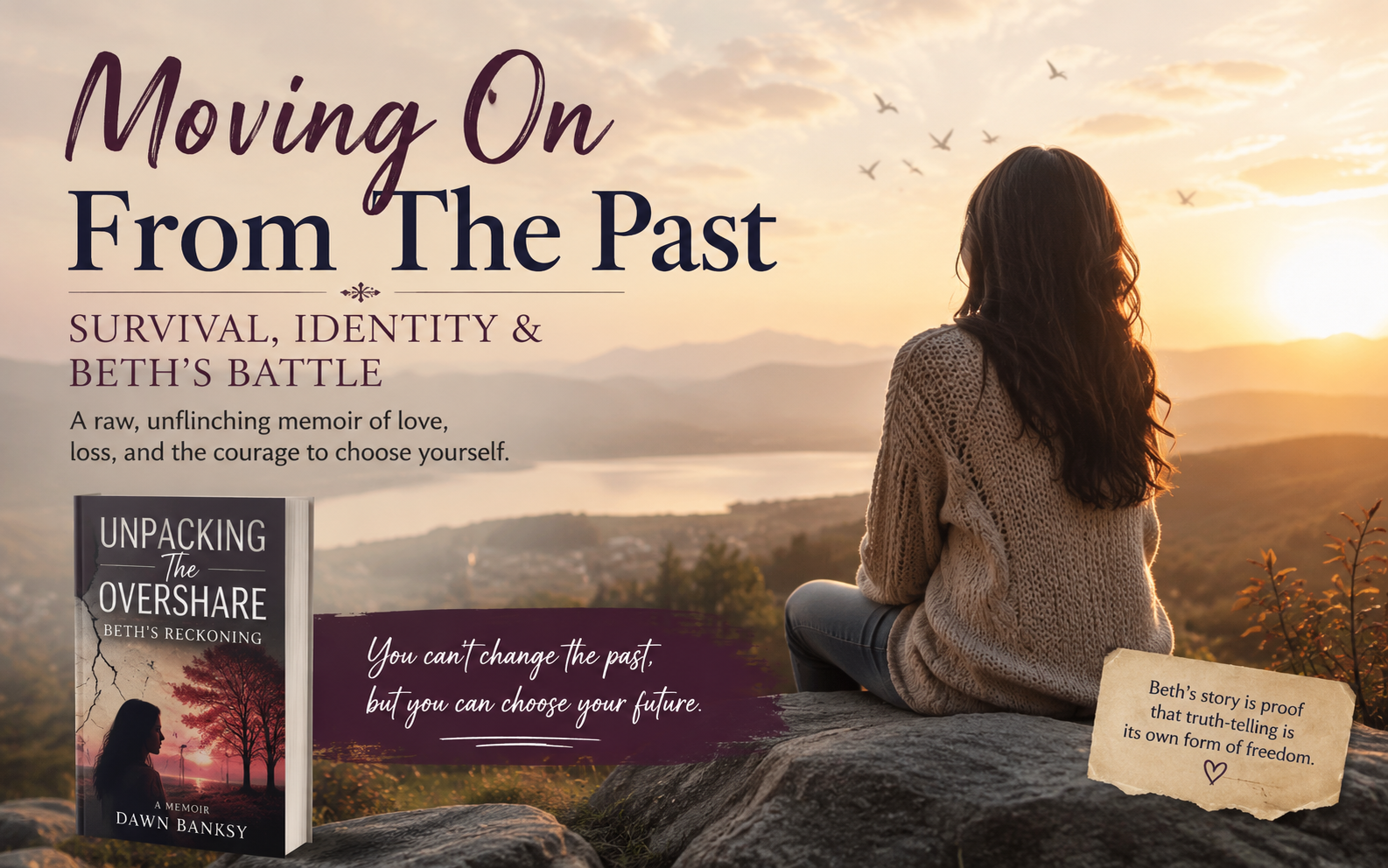
“Unpacking The Overshare” is the story of Beth—a raw, unflinching account of a woman willing to set her own life on fire for love, often in all the wrong places.
Moving On from The Past: Survival, Identity & Beth’s Battle
This memoir sits at the intersection of personal history and cultural reckoning—part survival narrative, part identity excavation. Beth’s story is for readers who’ve wrestled with family relationships, motherhood, faith, and the deep cost of always being the one to hold it all together. For those who grew up unseen, unheard, or misunderstood, Beth offers more than a story—she offers proof that truth-telling is its own form of freedom. Hers is not a journey of healing, but of brutal honesty and moral complexity.
Beth’s Struggle to Let Go: Moving on from The Past
We’ve suffered many sleepless nights. Nights when we were so preoccupied with something that happened in the past that we let it dictate our future. We’ve all been there at some point. You’re not alone.
We are talking about those moments when we can’t shake off the past. Whether it’s something small, like making a bad first impression or saying something we wish we hadn’t, or something big, like having to close your business. Obsessing over negative experiences is painful, and when we cling to that pain, we can’t move on to something more positive.
Beth’s Lesson: Learn From the Past, Don’t Live in It
Yes. In theory, that is possible. However, as Beth’s story clearly illustrates, there is a huge difference between knowing this and implementing it in real life. It was always hard for Beth to draw lessons from her experience and move on to something new.
You can learn from your experiences by asking yourself these simple questions:
- What really happened? Answer by facing only the facts.
- What emotions am I feeling? Personally, I like to write them down.
- How can I use this to empower myself and my feelings?
After answering these questions, it’s time to move on. While reflecting on the past for a short period is acceptable, obsessing over it will only keep those negative thoughts and feelings present.
Beth’s Truth: Express Yourself
Don’t hesitate to let out the pain you feel inside, whether it’s by talking to the person who hurt you (or whom you hurt), venting to a friend, or writing it down. Expressing your feelings can help you determine what, if anything, needs to be done to move forward.
Most importantly, it’s good for your health. Beth’s account in Unpacking The Overshare shows how holding onto pain—especially in silence—can lead to anxiety, depression, and years of hidden suffering.
Beth’s journey illustrates how crucial it is to let your emotions out, but it is wrong to say that Beth always did that on her own. In most cases, Beth bottled up her sadness and could not forgive others and herself.
Beth’s Rule: Stop Pointing Fingers
Playing the victim is easy and sometimes feels quite good, especially compared to accepting the truth. The problem is that blaming others prevents you from moving forward. In most cases, pointing fingers is nothing more than complaining.
Beth’s Way Forward: Focus On The Present
One of the most effective ways to let go of the past is to embrace the present. Instead of reliving the past and wallowing in negativity, stay active and enjoy the current moment. Learn something new. Meditate. Exercise. Have dinner with a friend. Make new friends. Whatever it is, live in the moment, even if it’s just sitting at your desk and watching the clouds drift by.
Living in the present moment, also called mindfulness, “involves being with your thoughts as they are, without clinging to them or rejecting them.” Psychology Today states that “mindful people are happier, more exuberant, more empathetic, and more confident.”
To achieve a state of mindfulness, be aware of your thoughts and feelings, reduce self-consciousness, seek out new experiences, and accept negative feelings and situations as part of life.
Beth’s Method: Unplug & Gain Perspective
Permit yourself to take some time to clear your mind. You don’t have to backpack through Europe. Just step away from the situation by distancing yourself from the people, places, and things that remind you of the past. Practicing ways to disconnect for a while will allow you to experience something positive, even if it means camping somewhere nearby with no access to social media.
When you return, you’ll have perspective on the past.
Beth’s Advice: Reevaluate The Company You Keep
Take stock of the people in your life. Who is negative and always makes you feel bad? Who are the people associated with your past that you’re trying to distance yourself from? Beth, for example, struggled with this very thing—she often chose friends unwisely and found it difficult to break free from negative influences, a pattern that repeated itself over the years.
Beth’s Challenge: Forgive Others—And Yourself
If someone has hurt you, the last thing you probably want to do is forgive them. Forgiving others is essential for spiritual growth, for making a new agreement with yourself, for not going to bed angry, and for being kind and generous.
While you are doing this, forgive yourself. No one is perfect, and everyone makes mistakes. Rather than being angry with yourself about your past mistakes, cut yourself some slack and try to learn from them. Because you are no longer harboring resentment, you will be able to move on.
Beth’s Healing: Create New Memories
Finally, try to form new, happy memories that will be used to replace the negative memories of the past. Spend your time on people who give you happiness, activities that make you feel joyful, and places where you find peace. Forming new memories is much better than living in the past.
Unpacking The Overshare stands apart from typical memoirs. Beth’s story is thought-provoking and morally ambiguous. It does not deliver solutions to the questions it poses but instead forces the reader to evaluate Beth’s actions and reasons. Positive thinking was not her forte; she had problems with forgiveness and was doomed to repeat her mistakes. Was there a time when she behaved differently? Decide for yourself.